


Riverside Expressway at 50: The Vital Road Beside Kangaroo Point

At the southern tip of Lower River Terrace, a network of walking paths and parklands quietly unfolds beneath the towering concrete belly of the Captain Cook Bridge. Above, thousands of motorists hustle along the M3, crossing the Brisbane River directly into the mouth of the Riverside Expressway.


This specific junction is where the leafy riverside of Kangaroo Point collides with one of Brisbane’s busiest transit corridors.

On 22 July 2026, the Riverside Expressway officially marks its 50th anniversary. While the vast majority of this elevated highway hugs the edges of the CBD, its southern terminus is permanently anchored to Kangaroo Point via the Captain Cook Bridge.

For residents, cyclists, and pedestrians, this massive infrastructure isn’t a distant freeway; it is a towering neighbor built right alongside their riverfront boardwalks, parks, and apartment complexes.

The Motorway Meets the Suburb

The Captain Cook Bridge serves as the critical link, carrying the Pacific Motorway over the water and depositing it straight onto the Riverside Expressway. While the bridge opened first in 1972, the completion of the expressway four years later forged an unbroken highway system across the city’s edge.

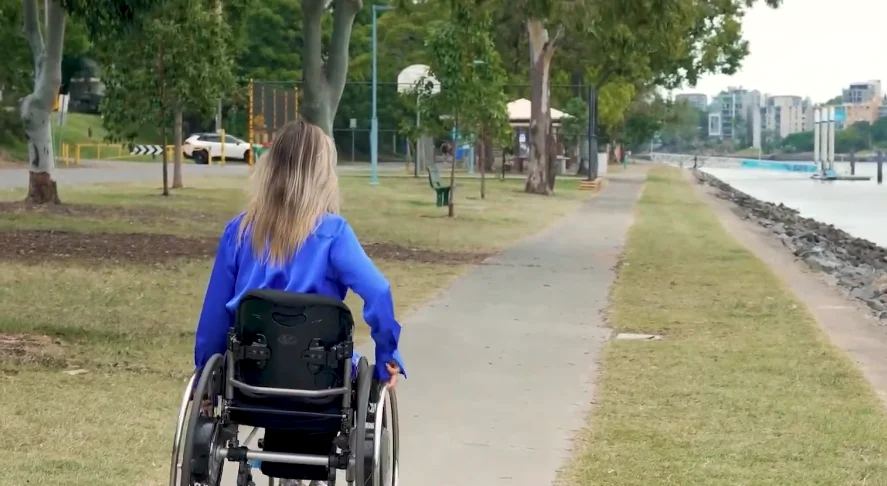
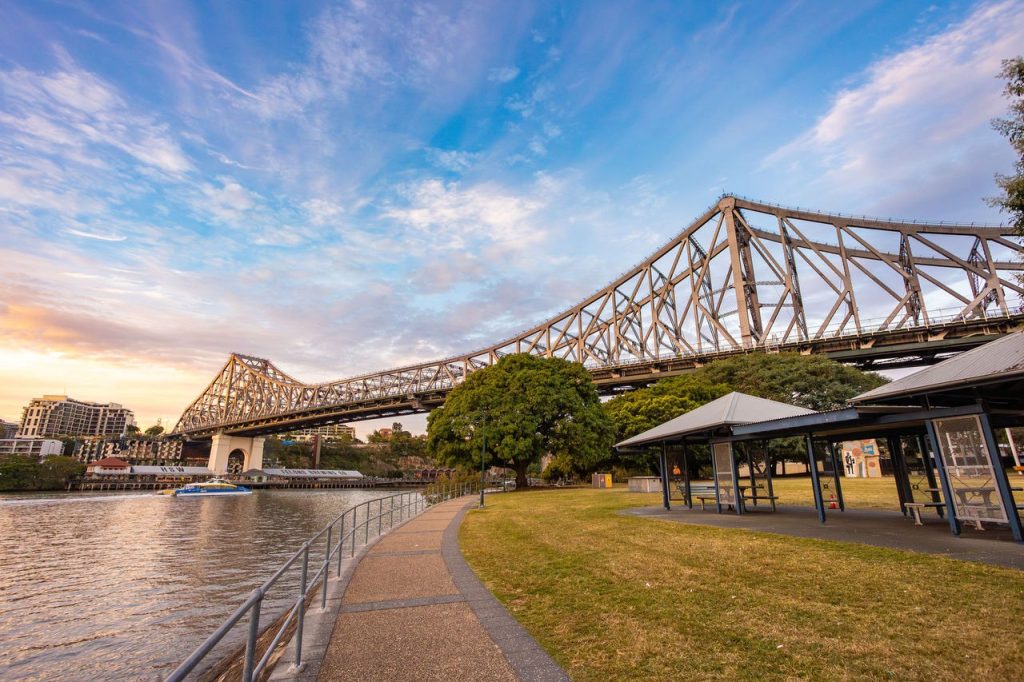
This physical footprint roots Kangaroo Point firmly in the expressway’s 50-year history. The infrastructure doesn’t just affect local commuters; it actively reshapes the suburb’s landscape. The Kangaroo Point Bikeway snakes from Thornton Street right up to the bridge, where it meets the popular Cliffs Boardwalk winding from the Riverlife Adventure Centre.

This tight wedge of land on Lower River Terrace is a masterclass in shared urban space. It serves as the northern launchpad for Veloway 1 (V1)—the major dedicated bicycle highway running south—meaning that within just a few square meters, a major interstate motorway, dense residential apartments, and vital recreational corridors all coexist.

A Radical Plan to Beat 1960s Gridlock

By the mid-1960s, Brisbane’s narrow inner-city streets were choking under a growing volume of automobiles. To solve the crisis, American consulting engineering firm Wilbur Smith and Associates drafted the groundbreaking 1965 Brisbane Transportation Study. Their solution was to bypass the inner-city grid entirely by building an elevated expressway right over the Brisbane River.

Construction kicked off in 1968, a massive engineering feat that slowly draped concrete spans along the northern riverbank. On 22 July 1976, Queensland Governor Sir Colin Hannah officially opened the final 1.4-kilometre leg to a crowd of 300 guests.

Photo Credit: 100 Years TMR
Photo Credit: Alison Greer/Facebook

The ambitious $37 million project wasn’t without controversy. During the opening ceremony, a small band of conservationists staged a protest from the riverbank below. According to State Library of Queensland records, a Main Roads truck was deliberately parked in front of the demonstrators to block their signs from view—prompting the protesters to simply pick up their banners and march to a more visible spot.

The 2006 Closure: When the City Stooped to a Halt

Because Kangaroo Point shares such intimate space with the corridor, any hiccup on the expressway instantly reverberates through the suburb’s local streets. This vulnerability was starkly exposed during an emergency shutdown in October 2006.

During routine maintenance, inspectors discovered misaligned deck sections and a hairline 0.04-millimeter crack on the Ann and Alice Street ramps. Erring on the side of caution, authorities immediately shuttered the expressway between Elizabeth and Hale streets. While the main lanes reopened three days later once engineers deemed the structure underneath safe, the brief closure triggered an absolute gridlock:

  • Local Bottlenecks: A subsequent network analysis report revealed that traffic skyrocketed by 19 per cent at the intersection of River Terrace and Main Street in Kangaroo Point as drivers scrambled for alternative routes.
  • The Wider Ripple: Gridlock bled across the city onto Coronation Drive, Bowen Bridge Road, and various river crossings, while traffic on the Pacific Motorway itself plummeted as drivers actively avoided the city.
  • Mass Commuter Detours: An estimated 41,000 commuters had to alter their daily routines. Drivers delayed, staggered, or cancelled trips entirely, while thousands abandoned their cars to walk, cycle, or catch trains and buses.

Astonishingly, 40 per cent of those caught in the chaos didn’t even plan on crossing the river. The crisis proved that when the expressway goes down, local suburban streets bear the brunt of a gridlocked city.

Fifty Years of Coexistence

The sheer volume of traffic highlights the corridor’s immense role in Brisbane’s daily life. State data from 2019 indicated that the Captain Cook Bridge was already carrying over 120,000 vehicles every single weekday, cementing it as one of the state’s busiest structures—a number that has only climbed as Brisbane approaches the late 2020s.


As Brisbane celebrates 50 years of the Riverside Expressway on 22 July 2026, the anniversary carries a unique meaning for Kangaroo Point. It isn’t just a celebration of civil engineering or commuter convenience; it marks a half-century of a suburb intimately sharing its borders, its air, and its riverfront with the beating heart of Brisbane’s transit network.

Published 14-July-2026

Kangaroo Point Runners Voice Fears over Rising Street Harassment

Local female runners, including those traversing the popular Kangaroo Point circuit, are increasingly shunning solitary exercise as a rise in verbal harassment makes them fear for their personal safety in their own neighbourhoods.


The ordeal began at 5:30 am on a Monday, 6 July 2026, in the Redlands, but the ripples of this encounter have moved quickly through the wider Brisbane community. A local mother of two found herself being pursued by a car while on her usual route, subjected to a barrage of offensive comments that made her genuinely fear she would not see her family again. 

Reporting the event proved almost as traumatic as the harassment itself. After a previous attempt to involve police resulted in her being told the offender was harmless, she was forced to navigate three separate phone calls and multiple stations before finding an officer willing to take her details.

Why should a morning jog require such high levels of hyper-vigilance? Katie Dall, a professional running coach and the director of Club KT, sees the answer in the faces of the women she trains. Between her sessions at the Teneriffe Athletic Club and her own community programs, she hears the same stories repeated across the city. 

Many women have reached a point where they refuse to exercise alone after dark, choosing to train in packs instead. This isn’t just a preference; it is a defensive strategy. Even during the broad daylight of a Tuesday morning, runners are left scanning the road, measuring the distance to the next shop, and mentally preparing for the moment a vehicle might slow down alongside them.

Experts in the field argue that the current approach—which places the responsibility of safety onto the individual runner—is fundamentally flawed. While carrying a phone or choosing well-lit paths are common safety tips, they do little to solve the underlying issues causing this intimidation. Queensland Police have issued a brief statement affirming that everyone deserves to feel safe and that they treat reports of suspicious behaviour with seriousness. 


Yet, for many, the damage to their peace of mind is already done. Between the constant “looking over their shoulder” and the conscious choices regarding what to wear or where to run, the joy of the sport is being stripped away. These women are simply asking for the freedom to exercise in their own city without the shadow of fear trailing them every step of the way.

Published Date 13-July-2026

Inner City Brisbane Area Sports Results 10-12 July 2026


AFL

Toyota AFL Premiership

Sun, July 12, 2026 (Gabba, Brisbane • Yuggera – Turrbal) – Toyota AFL Premiership – Men – Round 18
• Brisbane Lions 149   |   Essendon 59


FQPL

Sun, July 12, 2026 (Ballinger Park (Buderim Wanderers & Sunshine Coast Wanderers)-Field 1) – FQPL1 – Men – Round 18
• Sunshine Coast Wanderers 0   |   Brisbane Strikers 2


NPL

Fri, July 10, 2026 (Nudgee Recreation Reserve-Field 1) – NPL – Men – Round 18
• Brisbane Roar B 4   |   Rochedale Rovers 1

Sun, July 12, 2026 (Luxury Paints Stadium (Lions FC)-Field 1) – NPL – Men – Round 18
• Lions FC 1   |   Eastern Suburbs 0


NBL1 North

Sun, July 12, 2026 (Northside Indoor Sports Centre) – NBL1 North – Men – Round 13
• Northside Wizards 88   |   Brisbane Capitals 100

Sun, July 12, 2026 (Northside Indoor Sports Centre) – NBL1 North – Women – Round 13
• Northside Wizards 88   |   Brisbane Capitals 60


QRL

Sat, July 11, 2026 (Totally Workwear Stadium, Brisbane) – QRL – Men – Round 17
• Brisbane Tigers 30   |   Souths Logan Magpies 16

Sun, July 12, 2026 (Totally Workwear Stadium, Brisbane) – QRL – Women – Round 6
• Brisbane Tigers 32   |   Souths Logan Magpies 24


A Brisbane Landmark Is About to Begin Its Biggest Transformation in 174 Years

A heritage estate that has defined the Kangaroo Point bend of the Brisbane River for more than 174 years is entering its most ambitious chapter yet, with Capella Hotel Group and Brisbane developer Verso Projects partnering to transform the Shafston House estate into a luxury residential precinct slated for completion in 2029.


The project will become the first branded residence of any kind in Brisbane, and only the third Capella Residences development in the world, joining Seoul and Bangkok.

A site shaped by more than 170 years of Brisbane history

Shafston House began as a single-storey cottage in 1851, one of Brisbane’s earliest private estates, set on a prominent Kangaroo Point bend overlooking New Farm and the river.

The property passed through several notable eras: it served as an Anzac Hostel for servicemen during World War I, was later used as a base for the Royal Australian Air Force, and most recently housed Shafston International College until the site was sold in 2020.

Prominent Queensland architect Robin Dods designed the estate’s 1904 additions, building on a legacy that includes Red Hill’s St Brigid’s Church and upgrades to the Brisbane General Hospital

Taking the site into the future, Kerry Hill Architects will spearhead the design of the new residential tower, drawing on a celebrated Asia-Pacific portfolio of high-end hospitality and luxury residential projects. 

Inside the new Shafston precinct 

The precinct will restore the historic Shafston House and integrate it with a new residential tower rising 28 storeys, with 51 dwelling units across the development.

Photo Credit: Verso Group

Two exclusive River Homes will be constructed along the riverbank, complemented by a private marina, porte cochère, and private basement parking.

Residents will have access to six swimming pools, landscaped gardens, wellness and recreation facilities, and Capella’s signature Living Room — a hospitality-inspired communal space designed to deliver the service standard of a luxury hotel within a private residential setting.

Photo Credit: Verso Group

The concept positions the precinct as one where residents are effectively the only guests.

Capella’s track record in Australia

The Singapore-based Capella Hotel Group is already present in Australia through Capella Sydney, its five-star property in the former Department of Education building in the CBD, which has collected international acclaim since opening in 2023.

The Shafston project marks the group’s first residential offering in Australia and extends its philosophy of restoring culturally and historically significant sites.

Verso Projects brings an $8.5 billion development portfolio and more than 6,000 dwellings in its pipeline to the collaboration. Chief Executive Steve Laffey said the partnership was built around a shared commitment to doing justice to the site’s significance.

“We feel honoured to be restoring Shafston Estate to its former glory, elevating it to new heights of luxury and excellence,” Laffey said. “By partnering with Capella — globally recognised for its refined approach to luxury hospitality and deep respect for cultural and historical context — we will elevate this project beyond a residential offering into a world-class destination.”

Capella Hotel Group President Roland Fasel said Brisbane was poised for something significant. “Brisbane is sitting on the cusp of something remarkable,” Fasel said, “and Capella Residences is our commitment to being part of that story.”

Timeline and contact

Private appointments are open now with enquiries via carly@shafstonestate.com.au. A display suite is expected to open in late 2026 ahead of the planned 2029 completion.


Published 8-July-2026

Kangaroo Point Residents Spared Major Rate Shock in Brisbane Budget

While many Brisbane suburbs are facing council rate increases of more than 7 per cent, Kangaroo Point homeowners will see only a modest rise of 0.56 per cent under Brisbane City Council’s new budget, placing the suburb among the city’s better-performing areas.


The $3.9 billion budget includes major spending on roads, parks, community facilities and transport infrastructure, alongside residential rate increases that average 3.97 per cent across the city. For the typical owner-occupier, this amounts to about $63 a year, or roughly $1.22 a week.

While the citywide increase remains below 4 per cent, some suburbs are facing rises of more than 7 per cent, while others will see little change or even a slight reduction in their rates bill.

Photo Credit: BCC/Facebook

Brisbane rates remain among the region’s lowest

Brisbane City Council adopted its 2026-27 budget on 18 June, outlining spending plans for the year ahead as the city continues to deal with population growth, infrastructure demands and rising costs.

LM Adrian Schrinner said the budget was designed to balance investment in local services and infrastructure while keeping residential rates lower than many other councils in South East Queensland.

The budget retains the council’s $60 on-time payment discount for eligible ratepayers. Pensioners will also receive additional support, with the maximum pensioner rates rebate increasing to $1,350.

Council figures show the average owner-occupier rates increase across Brisbane will be 3.97 per cent.

Property values continue to influence rates outcomes

Although Brisbane City Council sets the overall rating structure, the amount paid by individual households can vary considerably between suburbs.

Differences in land valuations and rating categories can result in some areas experiencing larger increases than others. This year’s figures show a wide gap between the suburbs at the upper and lower ends of the scale.

Suburbs with more than 7% increaseRate 
Bulwer (Moreton Island)7.50%
Cowan Cowan (Moreton Island)7.50%
Lake Manchester7.50%
Robertson7.47%
Wakerley7.47%
Runcorn7.44%
Middle Park7.43%
Mackenzie7.42%
Algester7.41%
Corinda7.33%
Eight Mile Plains7.32%
Sandgate7.29%
Brighton7.24%

Other areas such as Dutton Park, Fairfield and Enoggera Reservoir are expected to see slight reductions in rates, while suburbs including Kangaroo Point and Woolloongabba will experience increases of less than 1 per cent.

The variation means neighbouring suburbs can receive very different outcomes despite being part of the same council area.

Photo Credit: BCC/Facebook

What homeowners can expect next

Like councils across Australia, Brisbane is also facing higher construction and maintenance costs, as well as increased demand on local infrastructure as the city’s population continues to grow. These pressures have played a role in the council’s budget and rates decisions for the year ahead.


Updated rates notices will be issued to Brisbane property owners during the next billing cycle. Eligible owner-occupiers who pay on time will continue to receive the council’s $60 discount, while pensioners may qualify for the increased rebate support announced in the budget.

Residents seeking further information about how the changes affect their property can access detailed rates information and budget documents through Brisbane City Council.


Published 18-June-2026

Kangaroo Point Community Anticipates Sustainable Tower Proposing Affordable Living and Wellness Spaces

Architectural firm Shelta Co has designed a massive 22-storey modular residential tower to transform the skyline of Kangaroo Point, offering 106 new homes with a rare 21 per cent strictly dedicated to affordable housing.


Modern Living and Reduced Disruptions

tower
Photo Credit: DEV-2025-WGB-4054

The proposed mixed-use precinct will be located at 492 Vulture Street and 85 Linton Street, situated within the high-density Woolloongabba Priority Development Area. The design features a slender tower resting on a four-level podium. In a move that will likely please surrounding neighbours, the applicants plan to use modular construction methods.

This modern building approach is designed to speed up the overall construction timeline, heavily reduce material waste, and improve efficiency, meaning less noise and long-term disruption for the local community.

Prioritising Pedestrians and Pedals

Aimed at encouraging active lifestyles over heavy traffic, the development focuses heavily on foot and bicycle travel. The site plans include just 72 vehicle parking spaces, accessed only via Linton Street, but feature a massive 220 secure parking spots for bicycles. 

Residents and locals will also have access to dual pedestrian entries on both Vulture and Linton streets. The ground and lower levels are designed to be a community hub, offering two food and drink outlets, multiple office spaces, and a massive wellness centre and gymnasium spanning roughly 1,000 square metres.

Subtropical Design for City Dwellers

tower
Photo Credit: DEV-2025-WGB-4054

The project embraces the local climate through a specifically subtropical architectural response. The building integrates green walls and highly landscaped communal spaces, providing over 2,300 square metres of outdoor recreation areas spread throughout the podium and the tower. 

These design choices aim to maximise natural sunlight, increase cross-ventilation, and capture wide city views for the residents. The residential portion consists mainly of two-bedroom apartments and a single penthouse, providing comfortable living quarters tailored to modern urban families and professionals.


Pushing Height Limits for Housing

The proposed 22-storey height slightly exceeds the current 20-storey limit established for this specific precinct. However, urban planners from Blume argue that the project is a well-considered and forward-thinking response to the evolving nature of the city. The planners note that the extra height is heavily justified by the inclusion of vital affordable housing options and the urgent community need for residential growth. They assert that the site is perfectly located for a high-density, transport-oriented development, matching the strategic growth planned for the surrounding Woolloongabba area.

Published Date 17-June-2026

Woolloongabba Neighbourhood Faces Major Redesign with Three-Tower Project

A massive new neighbourhood project featuring nearly a thousand homes, a hotel, and expansive public parks is set to transform a major intersection in Woolloongabba into a bustling community hub.


A New Look for the Local Area

project
Photo Credit: DEV-2026-WGB-4763

The proposed Mark Lane development targets a large 1.27-hectare site where Woolloongabba, Kangaroo Point, and East Brisbane meet. Designed by architectural firm Woods Bagot, the project features three distinct towers sitting on top of a shared, landscaped base. 

The designers drew inspiration from traditional Queensland timber screens and the natural colours of the nearby Kangaroo Point cliffs. By including extensive subtropical plant life and rooftop gardens, the builders hope to create a green destination for locals and visitors alike.

Housing and Accommodation

project
Photo Credit: DEV-2026-WGB-4763

If the local council approves the plans, the precinct will provide a significant boost to local housing. The plans detail 953 new residential apartments spread across two main high-rises. The tallest building, Tower 1, reaches 50 storeys and contains 683 apartments ranging from one to three bedrooms. Tower 2 stands at 34 storeys and holds 270 apartments, including larger four-bedroom options for families. 

A third, 11-storey tower is dedicated entirely to short-term accommodation, offering approximately 177 hotel rooms ranging from standard suites to premium spaces.

Focus on Public Spaces

project
Photo Credit: DEV-2026-WGB-4763

A major focus of the design is how it serves the surrounding community. The ground level features more than 2,600 square metres of privately owned space that the public can use freely. This includes the new Mark Lane Courtyard, a large community square, and a landscaped walking path called the Ant Trail. These areas will connect the property to Main Street and Vulture Street. 

The lower levels will also feature retail shops, dining spots, bars, office spaces, a new childcare centre, and a dedicated community facility that could potentially serve as a local library. To support the influx of people, the site includes parking for over a thousand cars and roughly 1,200 bicycles.


Planning and Future Stages

Because of its massive size, the construction will happen in stages. The first stage focuses on the underground parking, the shared base, Tower 1, the childcare centre, and the primary public squares. Later stages will bring the second residential building, the hotel, and further retail spaces. 

Planners from Urbis noted that the layout deliberately aims to improve foot traffic between the future Cross River Rail Station, the local sporting arena, and the Kangaroo Point cliffs. They also stated that the current design is the result of two years of talks with state developers to ensure the area has good street-level activity, respects cultural history, and provides safe walking routes for residents.

Published Date 17-June-2026

Preliminary Designs Released for New Kangaroo Point Bikeway Along Shafston Avenue

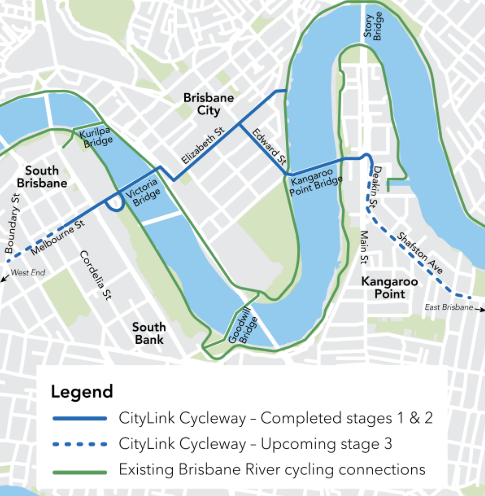
Brisbane City has released preliminary designs for a new separated bikeway along Shafston Avenue, extending the active travel corridor already established by the Kangaroo Point Bridge.


Read: Kangaroo Point to Anchor Major CityLink Cycleway Expansion


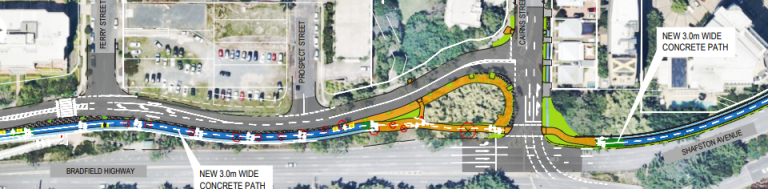
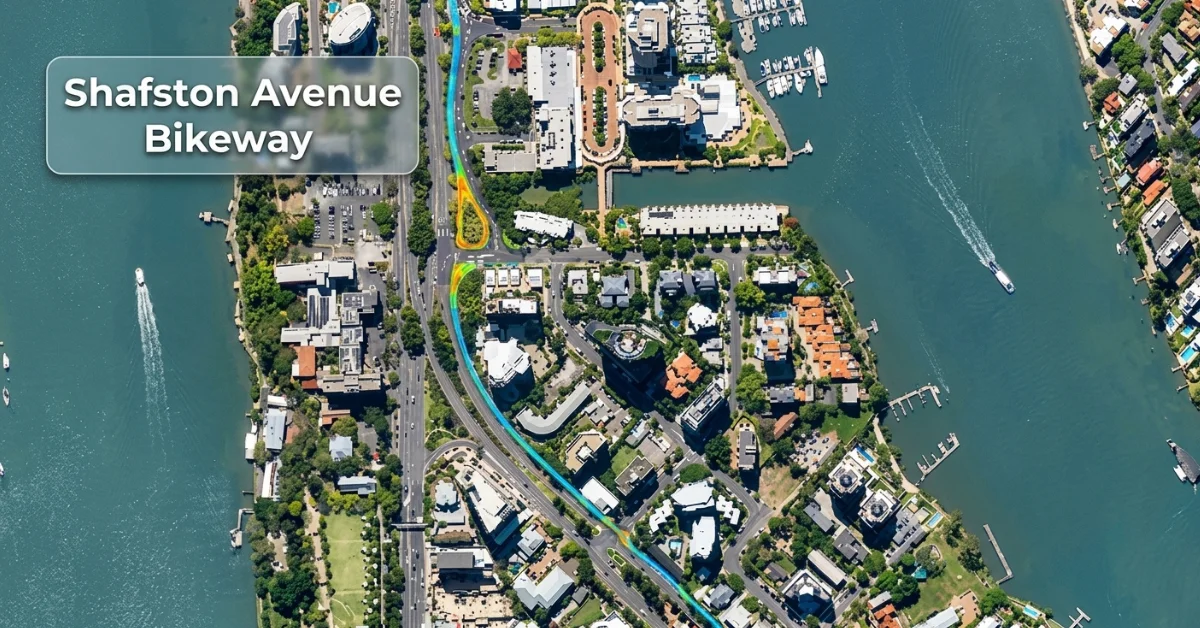
The 1.2-kilometre Shafston Avenue Bikeway will run between Deakin Street at Kangaroo Point and Mowbray Park at East Brisbane, delivering a two-way cycleway and a separate footpath along a stretch long identified as difficult and dangerous for cyclists.

Shafston Avenue Bikeway Preliminary Design (Photo credit: BCC)

Plans released ahead of the 2026-27 budget showed dedicated lanes for cyclists travelling in each direction and a third lane reserved for pedestrians. Several pedestrian crossings are also planned, including at Thorn Street and Castlebar Street.

Photo credit: BCC

The project forms part of Stage 3 of the CityLink Cycleway program, jointly funded under a 50-50 agreement with the state, through the Cycle Network Local Government Grant program. The final design is expected to be released late in 2026, with construction scheduled to begin in 2027. Costs have not yet been confirmed.

A gap that needed filling

Cyclists travelling between the eastern suburbs and the CBD have long flagged Shafston Avenue as a problem stretch. Norman Park retiree Richard Boys, who regularly rides toward the city, described the avenue as the roughest part of his route and said a proper bikeway would give him a continuous and safer link through to the inner city.

Belinda Ward, a spokesperson for cyclist advocacy group East BUG, said the upgrade was long overdue. East BUG was among the groups consulted during the planning process, with early designs initially proposing a shared path before being revised to include the separated bikeway and footpath that feature in the current preliminary plans.

Ward said the eastern suburbs had been overlooked for a long time, and while the Shafston Avenue project was a positive step, there remained much more to be done. She noted that past announcements had not always translated into action, and said what mattered most now was seeing construction actually get underway.

What the project will deliver

Photo credit: BCC

Once complete, the bikeway will create a direct and safer route between the eastern suburbs and the city via the Kangaroo Point Bridge, improving the connection for people walking, riding and scooting. The upgrade is part of a broader expansion of the CityLink Cycleway, which also includes a planned extension of the existing bikeway along Melbourne Street in South Brisbane, connecting the recent Victoria Bridge to Cordelia Street link through to Boundary Street in West End.

Stages 1 and 2 of the CityLink Cycleway became permanent in 2022 following a successful trial period.

Cr Adrian Schrinner said the project was about keeping pace with the city’s growth. “As our city grows, we need a transport network that makes active travel easier, helping residents leave their cars at home and reducing congestion on our roads,” he said.

Council infrastructure chair Ryan Murphy said the bikeway would give residents safer, easier travel options as Brisbane continues to grow.

Brisbane also highlighted the detailed planning behind the design. “Shafston Avenue is a busy and important road for all modes of travel travelling to and from the eastern suburbs. We have completed detailed traffic modelling to help us make balanced changes to intersections and local traffic access to include safe and efficient movements for people walking and riding. This work will help all of our community get home sooner and safer.”

A project years in the making

The Shafston Avenue corridor has attracted various proposals over the years. In 2020, a $22.5 million plan was announced to close gaps in the Riverwalk at Kangaroo Point and create an unbroken path linking Kangaroo Point and Mowbray Park. In 2024, a separate $35 million proposal was put forward to upgrade the existing bike route along Shafston Avenue into a separated cycleway.


Read: Kangaroo Point Bridge Opening to Boost Brisbane Connectivity


The current project builds on those earlier proposals, with a preliminary design now public and a construction timeline confirmed.

More information on the Shafston Avenue Bikeway is available at brisbane.qld.gov.au

Published 16-June-2026

Vacant Lot Near the Kangaroo Point Bridge Attracts Nearly $2 Million Buyer

A vacant corner block minutes from the Kangaroo Point Bridge has changed hands for $1.825 million, in what agents are calling one of the rarest land offerings in the inner-city market.


Read: Eighteen Apartments and a Rooftop Terrace: What’s Proposed for Two Bell Street House Lots in Kangaroo Point


The 506 square metre lot at 23 Kennedy Terrace, East Brisbane, has no house on it. No slab, no frame, no garden. Just land. And yet it fetched well above the suburb’s current median house price of $1.69 million when it was purchased by a private buyer in late May 2026, according to Ray White Bulimba.

The property’s history adds context to the price. The block last traded in 2025 for $1.58 million, at which point the existing home on the site, a one-bedroom, one-bathroom house built back in 1979, was demolished by the incoming owners. That original home was purchased the year it was built for $25,700, roughly $153,295 in today’s money when adjusted for inflation.

Approved architectural designs for 23 Kennedy Terrace (Photo credit: Ray White Bulimba)

The new owners had secured development approval and architectural designs from OH Architecture for a bespoke luxury residence before a change in personal circumstances meant they needed to move on. The block went to market in April through Ray White Bulimba, positioned as a rare opportunity in one of Brisbane’s most tightly constrained inner-city markets.

It eventually changed hands for $1.825 million, more than $245,000 above its 2025 purchase price, and over $100,000 above the suburb median.

Ray White Bulimba principal Brandon Wortley said the buyer was relocating from Melbourne, with their sights set on building a dream home in Brisbane. He pointed to the area’s ongoing transformation as a major drawcard, noting that the lead-up to the 2032 Olympic Games was already attracting significant infrastructure investment and global attention to inner Brisbane. He added that opportunities to secure vacant land in the area are becoming increasingly rare.

Photo credit: Ray White Bulimba

Kennedy Terrace sits within easy reach of the Gabba precinct, which is earmarked for a major Olympic overhaul, and the block itself offers ground-floor city views thanks to a generous 34.5-metre frontage on its corner position, according to the Ray White Bulimba listing.

The sale comes as the broader precinct continues to attract attention, with the Kangaroo Point Bridge now linking the peninsula to the CBD via active transport.


Read: Brisbane River Icons Project Brings World-First Wheelchair-Accessible Flying Fox to Kangaroo Point


The approved plans from OH Architecture remain with the block, though the listing also flagged potential for subdivision or multi-residential development, subject to council approval.

For a patch of land with no structure on it, $1.825 million is a number that speaks for itself.

Published 12-June-2026

More Homes but Less Guest Parking for New Kangaroo Point Tower

Finding a parking when visiting friends in Kangaroo Point might soon get a little harder, as a local high-rise development changes its plans to include more homes and fewer guest spaces.


The building project, located at 99 Thorn Street, was already approved by the local council, but the developers recently lodged a new application to change the design. The updated plans by Plazibat Architects will increase the high-rise from 12 to 15 storeys. This extra height allows the developers to fit in 56 residential units in total, bringing a dozen new families into the riverfront suburb.

Parking and Shared Spaces

parking
Photo Credit: DA A007013156

With more people living in the building, the developers are digging an additional basement level. The number of car spaces for residents will increase to 118, while the bicycle parking area is also being expanded to encourage active transport. However, visiting family and friends might struggle to find a spot. The new plans reduce the visitor parking to just five spaces, which falls below the standard requirements for a building of this size.

Along with the parking changes, the building will see a minor increase in its overall footprint on the site. The rooftop area, designed as a shared space for neighbours to gather, is also getting a fresh layout to better serve the growing number of residents.

Fitting into the Neighbourhood

parking
Photo Credit: DA A007013156

Town planners at RPS Group, who are working on the project, argue that the property was originally zoned to handle 15-storey buildings. They note that the location is perfectly suited for the extra apartments because it sits close to local services, shops, and public transport. The planners also pointed out that the local council has already approved other nearby apartment towers at heights of 20 storeys or more, meaning a 15-storey building easily fits into the modern Kangaroo Point skyline.


A Lighter Look

parking
Photo Credit: DA A007013156

Adding more floors can sometimes make a building look heavy and block out the sky. To prevent this, the architects have completely rethought the outside of the upper levels. Planners stated that the design team removed older structural features, like a heavy trellis, and replaced them with extra glass. They explained that this large amount of glazing is meant to give the top of the tower a much lighter and more open feel, reducing the visual bulk as the building reaches its roof.

Published Date 08-June-2026