


Story Bridge Adventure Climb Proposes New North Peak Route

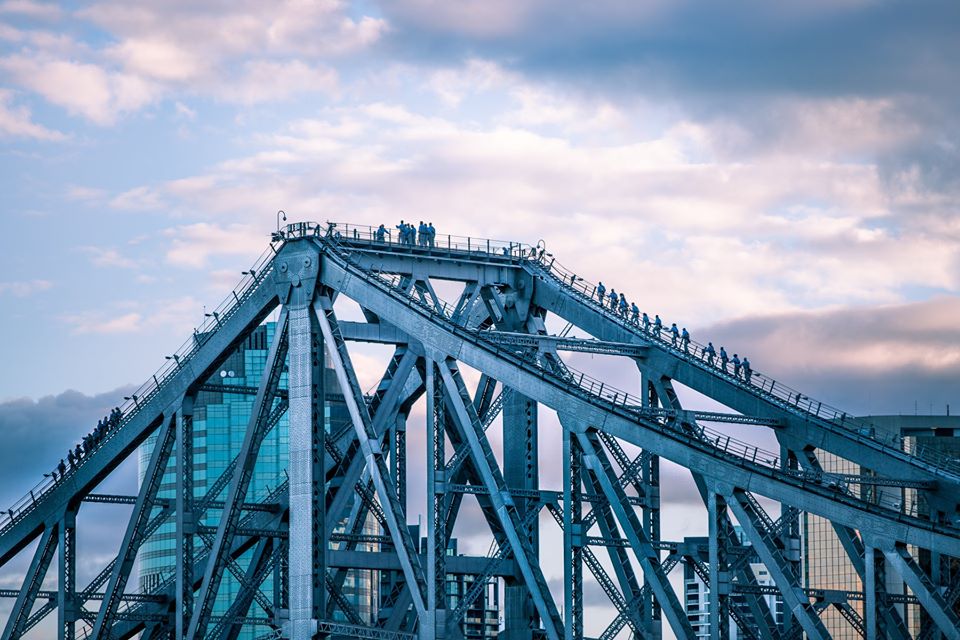
Fancy an unforgettable climb up the northern peak of the Story Bridge, hanging 74 metres in the air above the Brisbane River? Check out the Story Bridge Adventure Climb!

Though the Story Bridge Adventure Climb was first opened to the public in 2005, this iconic Kangaroo Point tourist attraction remains as active as ever almost two decades later. As one of only three bridge climbs in the world, daredevils and thrill-seekers have flocked from inside Brisbane and out to experience the climb themselves. In fact, plans have been drawn to expand the facilities available at Story Bridge.

With this latest proposal, Story Bridge Adventure Climb intends to provide tourists and visitors with a wider range of activities and climbs to meet the demand brought about by the rapid growth of tourism in Brisbane — one of which includes a new route for adventurers to take. 


A Development Application has already been submitted to the Brisbane City Council to create a second “north peak” route that co-exists with the current route available for daring thrill-seekers to climb. The proposal hopes to implement a viewing deck and a swing out to the Story Bridge.

The north peak route is set to run from Howard Smith Wharves all the way to the northern peak of the bridge, meaning the journey up the route would take an hour and a total of 550 steps to complete. It is expected that there is enough room for up to 14 climbers will be able to take on the route at any given time.

To book a trip up the Story Bridge in State Route 15, or to simply learn more about the Story Bridge Adventure Climb, check out their website. Follow them on their social media accounts on Facebook and Instagram for the latest updates. 

Story Bridge Now Offers World Exclusive Thrill-Seeker Activities

A world-exclusive climbing adventure is now yours to experience with the launch of two new thrill-seeker activities at the iconic Story Bridge this January 2020.

Tourism Industry Development Minister Kate Jones has announced that XBrisbane, the company that operates the bridge walks, is now offering the Walk the Plank and Cantilever adventure experiences. 

Walk the Plank,  XBrisbane principal John Sharpe described, is a one-metre plank that offers thrill seekers a “heart-stopping chance to walk out over the traffic 40 metres below.” The Cantilever, on the other hand, offers an experience of “weightless feeling of falling whilst being totally safe in a harness-and-suspension safety system.”

These offerings are just the start of more attractions to be offered soon to those looking for additional thrills at the Story Bridge.

“New experiences will grow our tourism industry and create local jobs. These new attractions will position the Story Bridge as Australia’s number one bridge adventure precinct,” Ms Jones said.

Story Bridge Now Offers World Exclusive Thrill Seeker Activities
Photo credit: Story Bridge Adventure Climb / storybridgeadventureclimb.com.au

Ms Jones added that the new attractions at the Story Bridge aim to attract an extra 45,800 tourists a year and generate an extra $3 million for local businesses. The State Government recently confirmed it will provide funding to support new attractions on the Story Bridge through its $36 million Growing Tourism Infrastructure fund.

Mr Sharpe said that the Sydney Harbour Bridge is “tired and old – their offering hasn’t changed in decades.” This major upgrade, he said, will make sure that thrill-seekers around the world will have the Story Bridge at the forefront of their mind.

“These adventure activities are not for the faint-hearted, but any true Queenslander will want to give it a crack,” he said.

Story Bridge Now Offers World Exclusive Thrill Seeker Activities
Photo credit: Story Bridge Adventure Climb / Facebook

The new climb activities cost $40 each or $50 for both, in addition to the Bridge Climb fee, starting from $129. Click here to know more about the Story Bridge Adventure Climb.


Road Closure Dates for Story Bridge Announced

Due to bridge inspection works on the Story Bridge, Brisbane City Council has advised the public about the road closures on Bradfield Highway in Kangaroo Point.

Roads will be closed between Kemp Street and Shafston Avenue from 4:00 am to 10:00 am on the following dates:

  • Sunday 30 June 2019 – 2 of 3 southbound lanes 
  • Sunday 7 July 2019 – 2 of 3 northbound lanes 
  • Sunday 14 July 2019 – 2 of 3 southbound or northbound lanes 

All lanes in the opposite direction of the road closures will be maintained. Signage and traffic controllers will be in place to direct motorists. For traffic information, visit QLDTraffic.qld.gov.au or call 13 19 40.

You may also visit www.brisbane.qld.gov.au or call Council on (07) 3403 8888.


The Story Behind Brisbane’s Iconic Bridge

In a story that has spanned eight decades, Brisbane’s iconic Story Bridge has helped shape the way of life of people in Queensland’s River City, particularly those in Kangaroo Point and New Farm.

The idea of constructing the bridge can be traced back to 1925 when the Cross River Commission assigned by the Greater Brisbane Council included the Story Bridge in their recommendation of major public works projects.

Before that, ferries ruled the day.

During the mid-1800s, people used horses and rowboats to ferry people or goods across the river.

In the 1860s, more ferries crossed the river and residents started to ride on steam ferry by the 1880s. The first steam ferry commenced operation between Charlotte Street and Kangaroo Point in 1883.

When the idea of a bridge was first broached, the State Government refused to fund it, finding it too expensive and frivolous.

Because of sectarian interests, the Story Bridge did not become a reality until after 10 more years.

The new Queensland Labor Government permitted the establishment of a Bridge Board in 1933 to plan a government-constructed toll bridge at Kangaroo Point.

Finally in 1935, the construction of the bridge commenced under consulting engineer Dr John Bradfield.

Dr Bradfield also designed the Sydney Harbour Bridge, the largest bridge in Australia. Evans Deakin-Hornibrook Constructions, known for their works in bridge building and enterprise, signed for the construction of the bridge.

Design and Construction

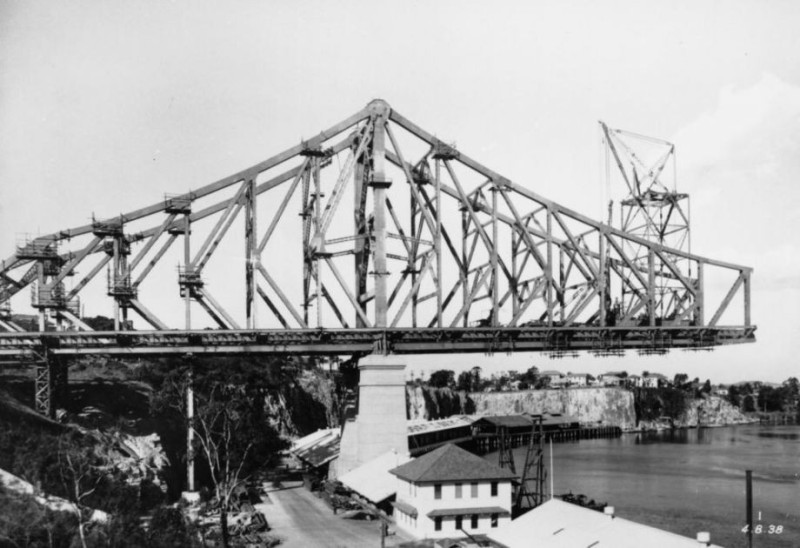
Story Bridge during construction of Stage four (Photo credit: State Library of Queensland)

The design of the bridge was inspired by the Jacques Cartier Bridge, a steel truss cantilever bridge crossing the Saint Lawrence River from Montreal Island in Montreal. Mr Bradfield, dubbed as the most likely person to handle the project based on his experience, recommended a steel cantilever bridge.

The construction of Story Bridge took five years, a year longer than what was planned due to shortage in steel. It used 12,000 tonnes of structural steel, 1,650 tonnes of reinforcing steel, 8,200 truck loads of concrete, and 1.5 million rivets.

Majority of the materials were manufactured in Brisbane, except for the steel that came all the way from Newcastle. The contract for the project cost around £1,154,000.

The bridge was considered a massive employment-generating scheme because more than 400 local residents were employed to work on site, office, and in the workshops. There were four deaths during its construction.

Sir Leslie Orme Wilson, Governor of Queensland led the opening of the bridge on 6 July 1940. The ribbon cutting ceremony was attended by more than 37,000 people, equivalent to 10-percent of the entire Brisbane population at the time.

Behind the Name

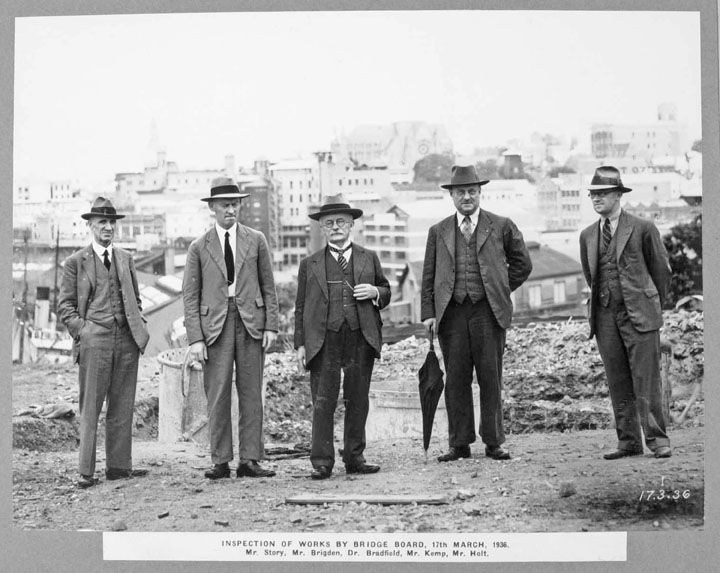
Inspection of works by Bridge Board – Mr Story, Mr Brigden, Dr Bradfield, Mr Kemp and Mr Holt in 1936 (Photo credit: Queensland Government)

The bridge was first referred to as the Central Bridge during construction. Later, it became known as the Brisbane River Bridge, based on the tender documents for the project.

Before it was renamed Story Bridge, it was also known as the Jubilee Bridge for King George V. It was named after John Douglas Story, a public servant and one of the advocates of the bridge.

Story was born in Scotland and migrated to Queensland when he was a child. He worked for the establishment of the University of Queensland and was a government representative on the University senate. He was Under-Secretary for the Department of Education between 1906 and 1920.

A Heritage-Listed Bridge

In October 1992, the bridge became a part of the Queensland Heritage Register because of its significance to the Queensland community, as a symbol of Brisbane and as the largest steel bridge designed, fabricated and constructed in Australia by Australians.

Its association with the life of a particular person, namely its significance as a major work by Queensland contractors Evans, Deakin & Co. Ltd and Hornibrook Constructions Pty Ltd, was also deemed a significant aspect of its heritage listing.


Story Bridge Adventure Climb

Brisbane day climb (Photo credit: Story Bridge Adventure Climb)

Today, the bridge is more than just a vehicle and pedestrian crossing. You can now enjoy the stunning panoramic views from the top by joining the Story Bridge Adventure Climb.

It’s a journey of almost a kilometre up over the bridge’s superstructure with a viewing platform 80-metres above the Brisbane River as it flows past the city heart.

The two-and-a-half hour climbing experience is a unique way to get to know more about the history of the Story Bridge and Brisbane’s transition from a 19th century penal settlement to a 21st century metropolis.  

Story Bridge in the Present

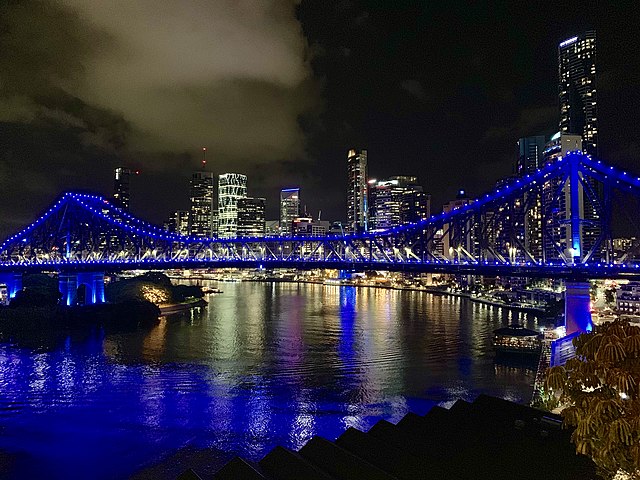
Story Bridge at night, taken January 2019 (Photo credit: Kgbo/Wikimedia Commons)

The bridge has undergone various restoration work most of which involves stripping old paint and cleaning it, scraping and blasting off the old paint and then completely repainting the bridge the same colour.

The five-year restoration of the bridge, currently ongoing, is expected to require more than 33,000 litres of paint, at a cost of around $80 million.

To this day, it remains a vital part of everyday life in Brisbane. Not bad for an 80-year-old.

Story Bridge to Get $80M Worth of Restoration

The Story Bridge has stood the test of time but as it approaches its 80th year in 2020, Brisbane City Council has initiated a 5-year, major restoration to continue to help residents get home quickly and safely.

With an aim to prolong the life of the 79-year-old bridge connecting Fortitude Valley to Kangaroo Point, BCC is planning to blast bare, paint and restore it.

Planning for the Story Bridge restoration began in February 2019, wherein the Council will discuss stripping old paint, cleaning it and giving it a 105,000-square-metre face lift.

Lord Mayor Graham Quirk said the restoration will require more than 33,000 litres of paint. The Story Bridge’s steely-grey colour will be retained but they will scrape and blast off the old paint and then completely repaint the bridge the same colour.


Cr Quirk said it was vital that the Council continued to maintain the Story Bridge to ensure it continued to stand as an iconic figure on Brisbane’s skyline.

“Works are expected to commence after Riverfire and will be carried out in stages over a five-year period to ensure the Story Bridge can continue to be used by traffic and feature in some of our city’s favourite festivities,” Cr Quirk said.

The Story Bridge will not close during the paint job but some lanes will be closed during some stages.

Story Bridge History

The bridge’s construction, which lasted for more than five years, began in May 1935. The design for the bridge was based heavily on that of the Jacques Cartier Bridge in Montreal, completed in 1930. John Bradfield, the appointed consulting engineer to the Bureau of Industry, recommended a steel cantilever bridge.  

Kangaroo Point during construction of the Story Bridge Brisbane, 1938 (Photo credit: slq.gov.au)

Back then, 400 people were employed to build the bridge at the height of the construction, making it one of Queensland’s main employment-generating projects during the 1930s Depression.

The bridge was named after John Douglas Story, a senior and influential public servant who had advocated strongly for the bridge’s construction.


Story Bridge Top-ranked For Most Crash Reports

Motorists driving along the Story Bridge, the nation’s longest cantilever bridge, are urged to “slow down and take care merging.” The heritage-listed bridge that links Kangaroo Point to Fortitude Valley has been top-ranked for having the most crash reports, the latest report revealed.

Between 1 January 2015 and 31 October 2018, insurance claims records show that there have been 36 crash reports on the Story Bridge, the State’s peak motoring body, RACQ reported. Captain Cook Bridge and Gateway Bridge followed with 29 and 14 reported crashes, respectively.


“These bridges are often heavily congested, high volume, multi-lane crossings, making them hot spots for multi-vehicle crashes,” RACQ spokesperson Lucinda Ross said.

“Most are peak hour rear-end collisions, or sideswipes where drivers fail to give way changing lanes. Drivers need to take care merging and leave plenty of room between cars,” she said


Rounding out the top six are William Jolly Bridge (11), Walter Taylor Bridge (10), and Go Between Bridge (4).

Ms Ross suggested that apart from public transport, the government also needs to invest on projects that will provide alternative routes to minimise congestions and offer vehicle access to and from Brisbane City such as upgrading Roma Street, North Quay, Stanley, and Vulture streets.

Three-Day Closure Of Story Bridge In Kangaroo Point; Free Toll On Clem7

Brisbane’s most iconic bridge, the Story Bridge in Kangaroo Point, will be closed for three days on 27-30 April as part of the Brisbane City Council’s waterproofing project.

The bridge will be closed between Main St and Bowen Terrace. There will be detours to divert traffic towards either the Captain Cook Bridge or through the Clem7. Clem7 toll will be free during the closure.

Over 100,000 cars use the bridge every day and with this upcoming closure, motorists must expect congestion in various parts of the city.

The works involve:

  • Asphalt removal from the concrete deck
  • Concrete cleaning
  • New asphalt top surface
  • New line marking
  • Bridge joint resealing

Police and traffic controllers will be present onsite to ensure safety for everyone.

The installation of a new waterproofing system is important to maintain the concrete elements.

The council also reminds residents near the bridge that they may experience some effects from the construction such as dust, noise, and vibration.

For changes to bus routes that cross the bridge, you can contact Translink on 13 13 20.